How Charming!

February 17, 2013 Photo of the day:
"How Charming!"

The precise history of charm bracelets is unknown, but it is believed that they began as a form of amulet worn to ward off evil spirits. Early charms were made of bones and shells, and later rocks, wood, and gem stones. There is evidence of charms being worn in ancient Africa and Europe as religious and political symbols. Charm bracelets became particularly fashionable during the reign of England's Queen Victoria. The queen herself wore charms and gave them as gifts. Upon the death of Prince Albert, Victoria had charms designed to hold locks of her husband's hair. During the 20th Century, soldiers returning from war often brought charms home for their loved ones. These charms were made by local craftsmen in areas where the servicemen were fighting. Charm bracelets gained popularity in the 1950s and 1960s when it became traditional for American girls to collect charms to represent milestones in their lives.

I love to travel, but I don't buy a lot of touristy trinkets. My photos and journals have always been my favorite souvenirs. However, I did buy a tiny white gold Figaro link bracelet was in Florence in 1994. Since then, I have added charms from many places that I have visited.
  • Cana Island Lighthouse: An iconic symbol of the Door County shoreline near my godparents' cottage in North Bay, invoking childhood memories of wading out to the rocky island and fishing on its shores.
  • 2000: A charm to mark the new millennium
  • Basque Cross: San Sebastien or Saint Jean de Luz - 2008. Its four arms signifying spirit, life, consciousness, and form.
  • Matador's Jacket: From Madrid's Plaza Mayor -1998.
  • "Big Ben": Houses of Parliament charm from London - 2002.
  • Sand dollar: Key West - 2006.
  • Sailboat: My grandmother bought this tiny charm for me in 1987 when I was on the Marquette University sailing team. I wore it around my neck for years, but when the chain broke the year after my grandma passed away, I had the charm soldered onto my bracelet.
  • Eiffel Tower: From my first summer in Paris in 1994.
  • Plumeria: This frangipani blossom with the pearl in the center was purchased in Hawaii during our honeymoon in 2005.
  • Dolphin: My mom bought this charm for me when my brother, she, and I swam with dolphins during the Christmas we spent in the Bahamas after my dad passed away.
  • Gondola: Venice - 1994

    Tiffany and Co. introduced their first charm bracelet in 1889 — a sterling silver link bracelet with a single heart next to the lobster claw clasp. This bracelet remains a best seller for Tiffany to this day. Mine was purchased at the Tiffany flagship store on 5th Avenue. The original heart is inscribed with my monogram. With the exception of a circular charm engraved with the town of Sturgeon Bay along with two sailboats (a gift from my husband), the rest of the charms have been added each time I return to New York. I have an iconic Tiffany blue box, a shopping bag, an Eiffel Tower, and a sailboat. 

    I don't wear a lot of jewelry, but my charm bracelets are two of my favorite pieces. They are as personal as the memories that they invoke!

    La Langue de l'Amour

     
    February 14, 2013 Photo of the day: "L'amour"

    It's a familiar image, reminiscent of my February 3rd photo, but this time it's in French, the language of love. Happy Valentine's Day! If you want to spoil special someone today, try whispering sweet nothings en français ;) There are so many sweet and silly French terms of endearment! 
    • Traditional: mon cher, ma chérie (my dear, my darling), mon amour (my love), mon cœur (my heart), mon ange (my angel), ma belle (my beauty), mon mignon, ma mignonne (my cutie), mon trésor (my treasure),  ma poupée (my doll), ma moitié (my half)
    • Pet names: ma chatte, mon chaton (my kitten), mon lapin (my bunny), mon canard (my duck), ma caille (my quail), mon poulet (my chicken), mon loup (my wolf), ma puce (my flea), and, be careful pronouncing this one: ma biche (my doe, a dear, a female dear...)
    • Silly: mon petit chou (my little cabbage!)
    If your mots doux come with des fleurs (flowers), des bonbons (candy), du chocolat (chocolate), ou des bijoux (jewelry), you are sure to get un gros bisous (a big kiss)!

    Don't forget to say: Je t'aime! or Je t'adore!

    Zou bisous bisous - XO

    *
    If you need even more lovely inspiration,
    visit by "Valentine's Day" Pinterest Board


    or for love in the most romantic of cities, visit "Paris, je t'aime!"


    Cyrano de Bergerac

    February 13, 2013 Photo of the day:
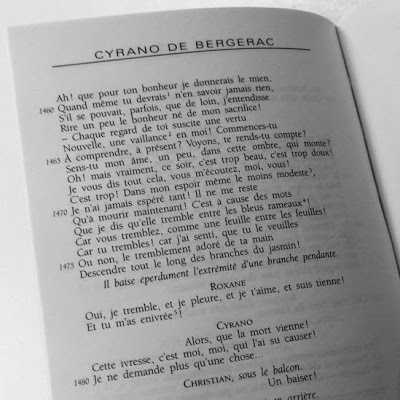
    "Pour ton bonheur, je donnerais le mien"
    ("For your happiness, I would give my own")
    ~ Cyrano de Bergerac Act III, Scene 7

    As I mentioned, my French IV students are studying the cultural, political, economic, and artistic aspects of 17th Century France as illustrated in Jean-Paul Rappeneau's brilliant 1990 film adaptation of Edmond Rostand's play, Cyrano de Bergerac. In case you're unfamiliar with the play or the film, it is a fictionalized account of Hercule-Savinien de Cyrano de Bergerac, a French dualist and dramatist. It is the story of love and war, of physical versus inner beauty. Cyrano is a talented soldier, a remarkable duelist, and a gifted poet. However, his talent is overshadowed by his unfortunate physical appearance, namely his ridiculously large nose. Cyrano is in love with the beautiful and intellectual Roxane (OK, I'll wait...You know you want to sing it: "Roxxxxane, you don't have to put on the red light..."), but alas, she is infatuated with the devastatingly handsome Christian. Despite his disappointment, Cyrano promises to protect his young rival. Upon discovering that Christian is as ineloquent as he is handsome, Cyrano also serves as ghost writer of the most romantic letters that Christian, in turn, uses to woo Roxane. The entire play is written in Alexandrine verse (rhyming couplets of twelve syllables). The 1990 film is particularly extraordinary since even the English subtitles, written by Anthony Burgess (author of A Clockwork Orange), maintain the original poetic form. France's renowned and often controversial actor, Gérard Dépardieu, won a César for his portrayal of Cyrano, and he was also nominated for a best actor Oscar, a rare honor for a non-English speaking role.

    My students have done character and poetry analyses. They have written reflections on whether they would be more attracted to someone who is physically beautiful or to someone with a great personality. They have compared the balcony scenes in Romeo and Juliet and Cyrano de Bergerac (featured in today's photo), and tomorrow for Valentine's Day, they will write love letters to Roxane emulating either Cyrano's or Christian's style. I love teaching this unit! The film illustrates so many historical and cultural concepts that we have studied, including the influence of Cardinal Richelieu and the Academie française, the war between the French and the Spanish, and the rise of the literary salons and the theatre. It is so exciting to see my students rooting for the underdog while learning to appreciate French literature and film!