December 19, 2013 Photo of the day:
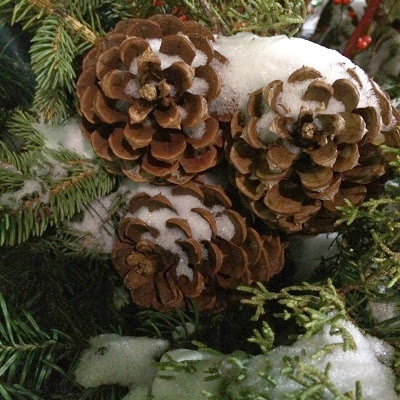
"Festive Fibonacci"
I love words -- literature, rhetoric, dialect, but math and science don't really excite me. Still, I've always been fascinated by the Fibonacci sequence and it's appearance in nature: pineapples, sunflowers, spiraling shells, and pine cones. I do appreciate math and science that further illustrate beauty, art, and order in nature. Theoretical biologist, Stuart A. Kauffman explains: “Pick up a pinecone and count the spiral rows of scales. You may find eight spirals winding up to the left and 13 spirals winding up to the right, or 13 left and 21 right spirals, or other pairs of numbers. The striking fact is that these pairs of numbers are adjacent numbers in the famous Fibonacci series: 1, 1, 2, 3, 5, 8, 13, 21... Here, each term is the sum of the previous two terms. The phenomenon is well known and called phyllotaxis. Many are the efforts of biologists to understand why pinecones, sunflowers, and many other plants exhibit this remarkable pattern. Organisms do the strangest things, but all these odd things need not reflect selection or historical accident. Some of the best efforts to understand phyllotaxis appeal to a form of self-organization" (Stuart A. Kauffman, At Home in the Universe: The Search for the Laws of Self-Organization and Complexity).